
By Geoff Wilson and Raisa Kochmaruk.
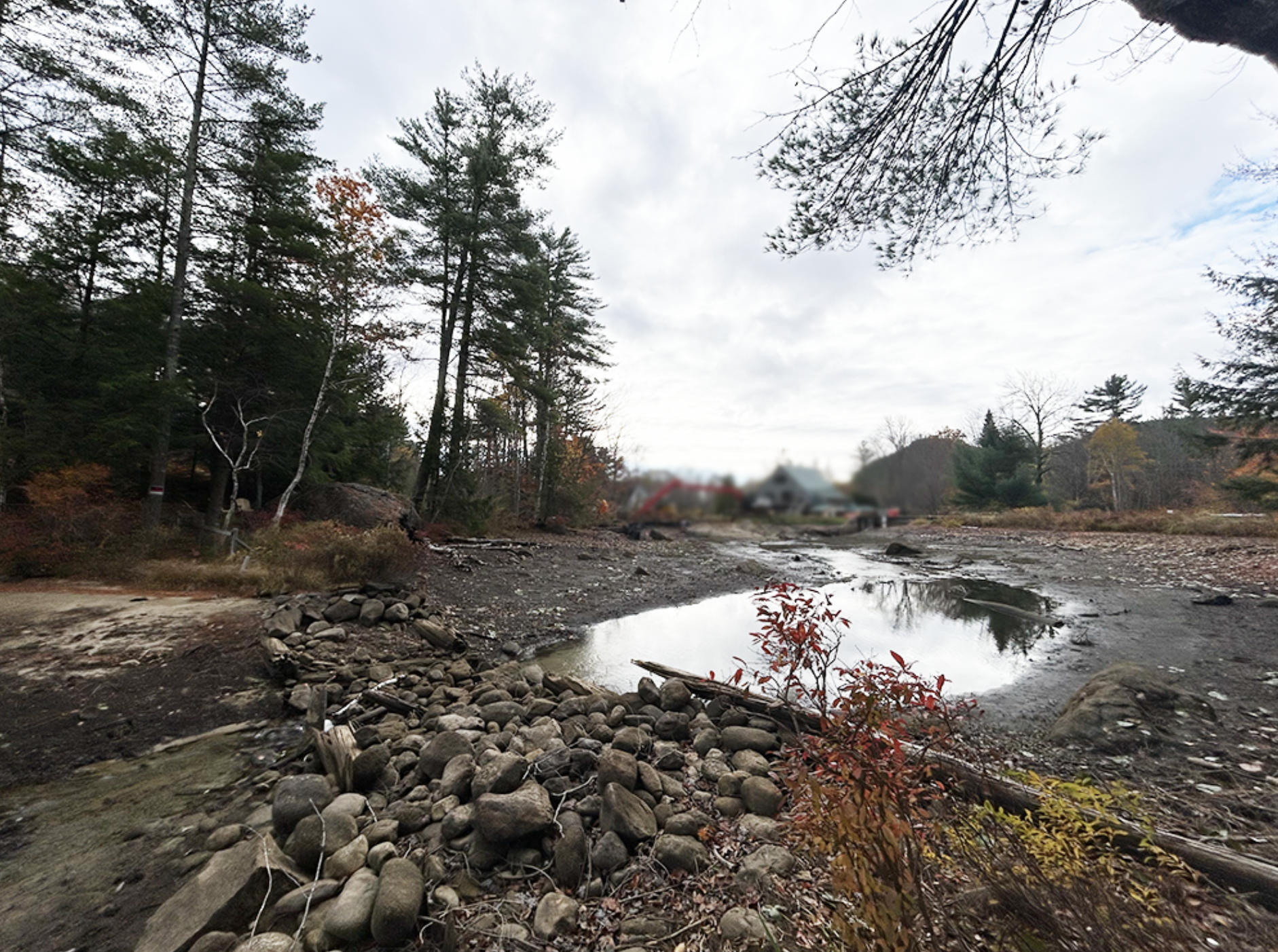
Mirror Lake’s original 19th-century dam (pictured above) is in the open air for the first time in 150 years.
This fall, Mirror Lake's water level has been reduced by about five feet as the New Hampshire Department of Environmental Services conducts maintenance on the modern dam. Along some sections of shoreline, the lake has shrunk inwards by about 15 feet. Large boulders that usually peek out of the surface are strewn across the open lakebed. The original dam, which has been well preserved underwater, appears as a small bridge of tumbled rocks at the lake's southern end (highlighted at right). Locals can walk across it if they traverse the exposed perimeter of the lake. To every living person familiar with the lake, this seems like a drastic change, but the lake we all know and love is the size it is due to a fascinating history of human alteration; the lower lake levels visible this fall are actually much more like what the early settlers to the Hubbard Brook Valley encountered.
Settlers began arriving in the Hubbard Brook Valley shortly after the Revolutionary War. One of the first was William Hobart, a former Revolutionary War soldier and blacksmith who started a farm on a lot bordering what we now call Mirror Lake in about 1783 ("Hubbard" is thought to have been derived from "Hobart"). It is this lot which hosted a succession of mills and industry which was the nucleus of a thriving farm and forest community closely tied to the surrounding landscape.
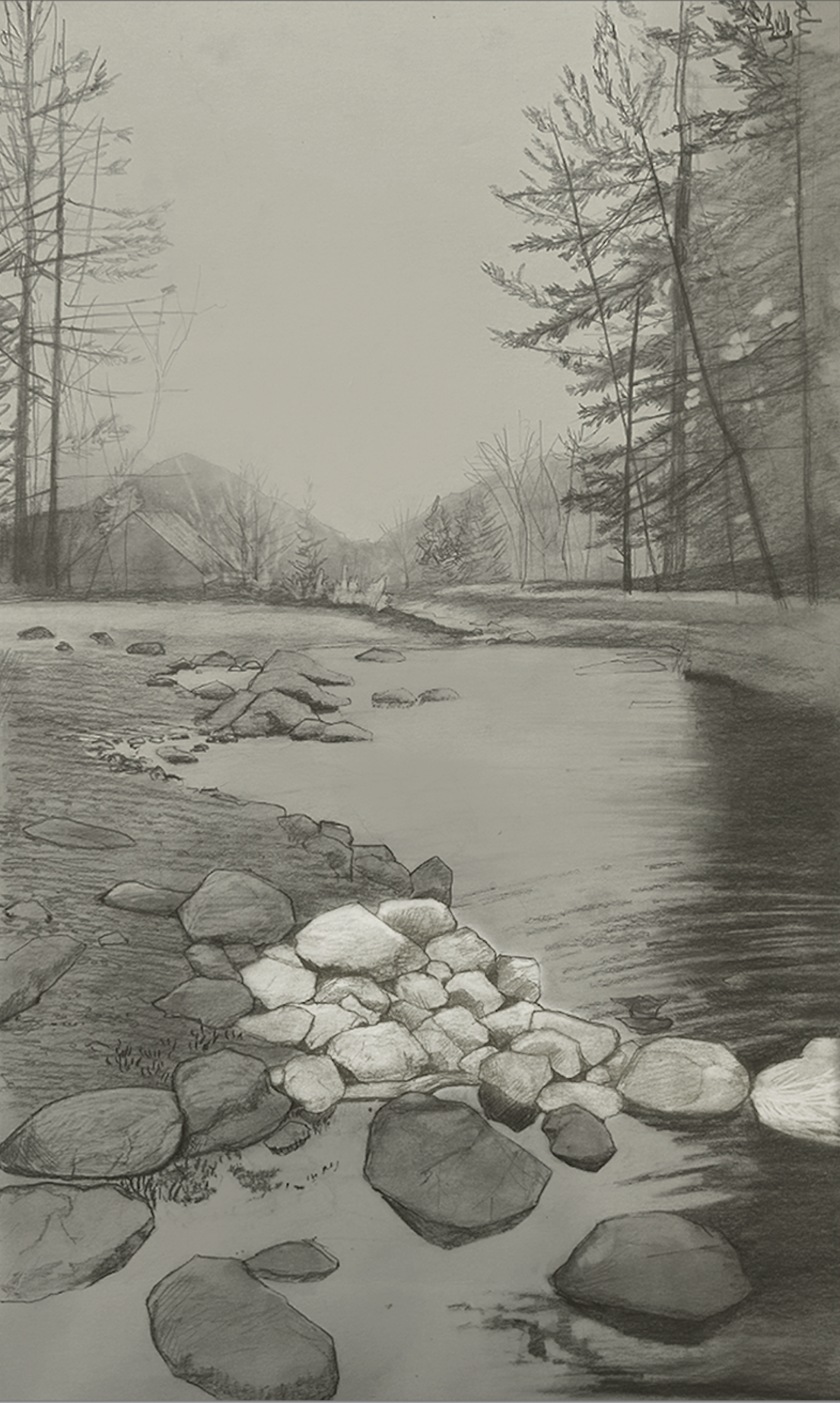
Illustration of exposed cribwork dam by Raisa Kochmaruk. Highlighted area shows remains of the rocks which would have filled a wooden lattice.
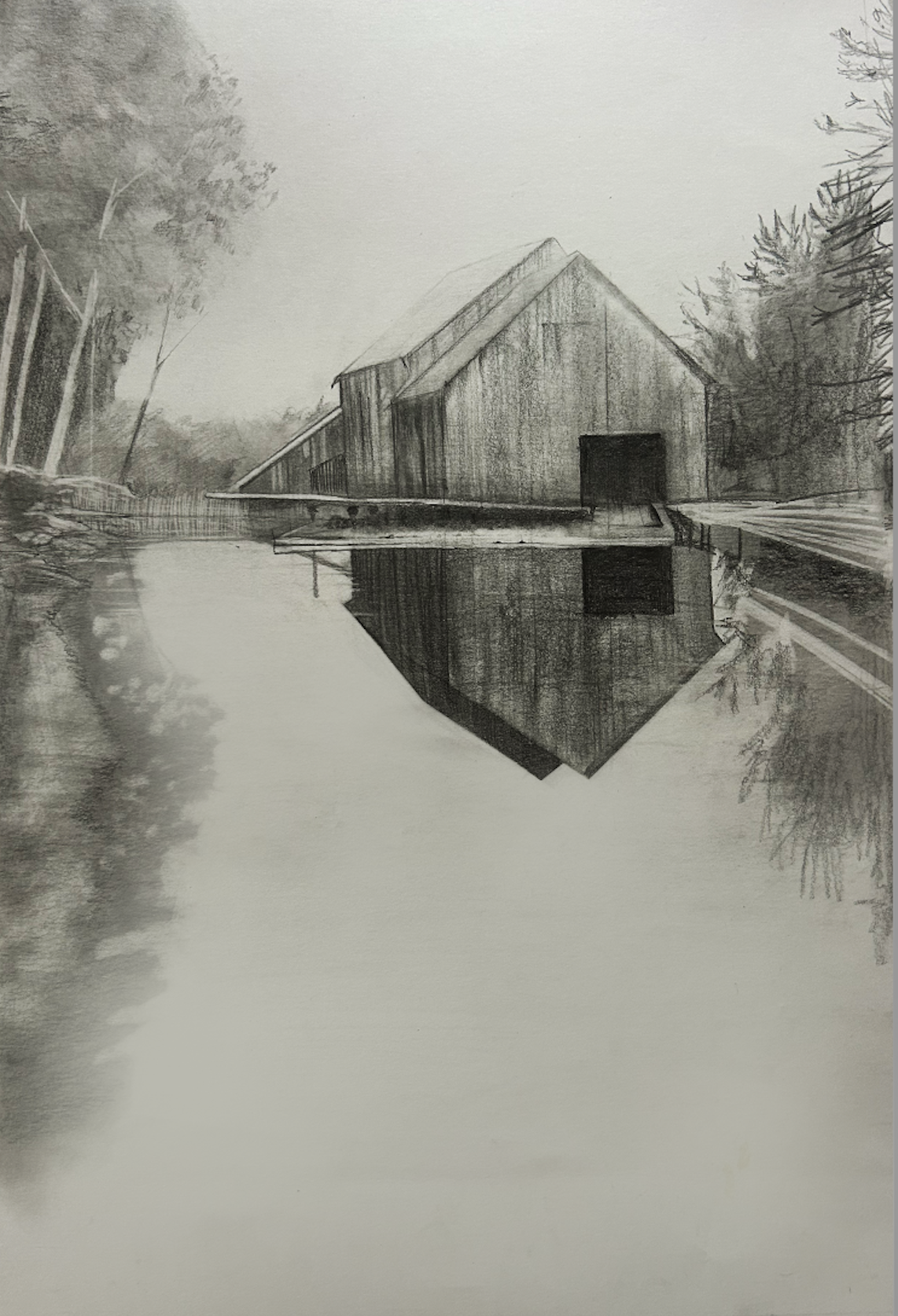
Visualization of logging mill on Mirror Lake by Raisa Kochmaruk. Based on historical photo.
It is unclear exactly when the first mill utilizing hydropower from the lake was built, but maps indicate that by 1817 there was both a sawmill and a grist mill along the outlet from the lake, emblematic of the hyperlocal economy of this time where settlers would use hydropower to saw building materials from trees and grind the grains they grew all from their homestead lots. These mills could have been built by Hobart, or by John McLelland, who bought the lot from Hobart in 1811. Based on tax valuations, McLelland's son Aaron clearly invested in the mills through the 1830s, suggesting a growing community around the lake.
The small mills and activity around the lake up until this point would be characterized as subsistence farming, with the mills serving the needs of the people in the local community. After McLelland sold the property in 1847, however, a small forest products industry grew, again powered by the hydropower available from the lake but now connected economically to a wider world. This included a series of mills with various owners, and perhaps most significantly a tannery begun by Warren White, with Richard and Alan Danforth, in 1851-52. In 1851 White obtained permission from the three other landowners around the lake to raise the level of "McLelland Pond" by three feet, and by 1853 he and his partners had begun a business which at its peak was processing 4500-5000 hides, many shipped in from the slaughterhouses of Chicago, and employing 10-14 people. The tannery was powered by two waterwheels along the outlet of "Hubbard Pond", and used bark from hemlocks cut in the surrounding area as a source of tannins. The dam we see now most likely dates to this time.
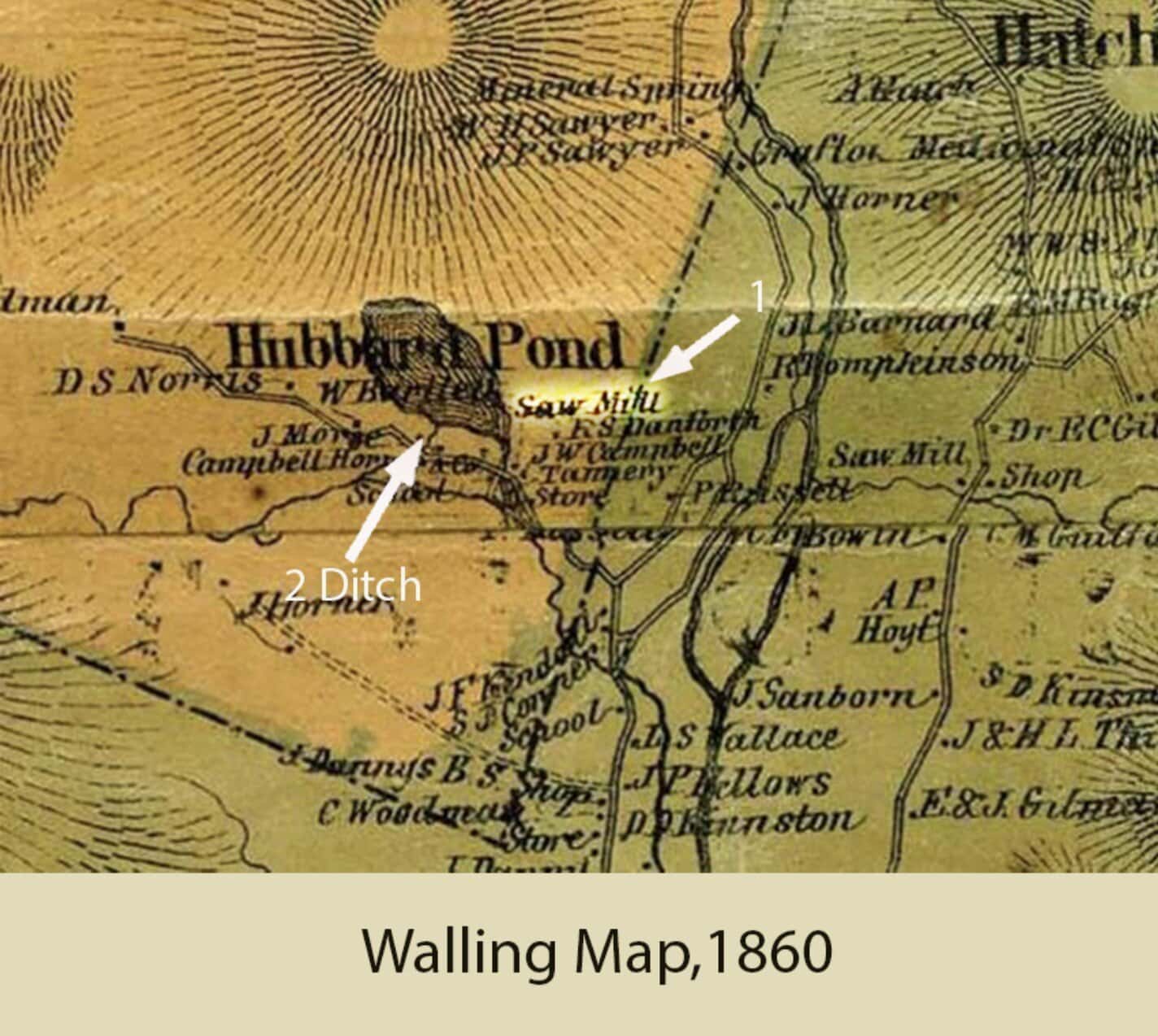
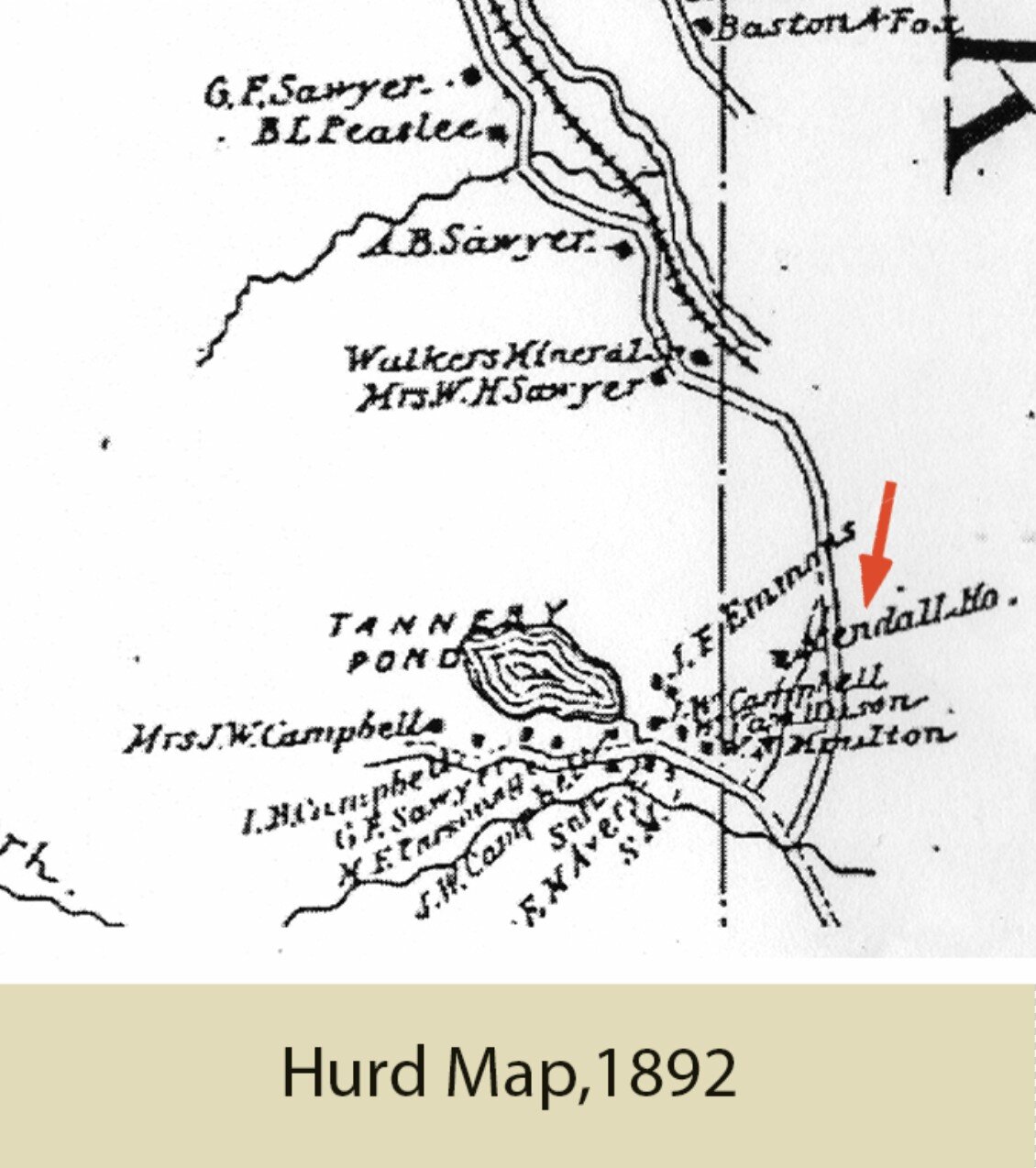
Above: Historical maps of the Mirror Lake neighborhood. Arrows on the 1860 map indicate the sawmill at the outlet of the lake and the ditch which allowed water from the Hubbard Brook to be diverted into the lake during the era the tannery was operating. The arrow on the 1892 map points to the Kendall House, now called Pleasant View Farm, which began taking guests in the early 1880s and has been housing Hubbard Brook researchers since the early 1960s.
The cribwork-style dam now visible was fashioned from a lattice of strong logs that was filled with rocks and mud and then reinforced with a wood panel facing inwards towards the lake. It raised the water level by three feet (the lake was later raised by another foot or so), allowing for some control over the water leaving the lake and powering the water wheels, which ran the machinery in the tannery and mills. In addition to the dam, around this same time there was a ditch dug from the Hubbard Brook to Mirror Lake that allowed water from the brook to enter the lake in order to keep water levels high enough to run the water wheels. This ditch is visible on the maps of the area published in 1860. At times, the lake was likely used to hold logs before they were processed, but it primarily played a role in providing hydropower for the growing forest products industry around the lake.
The tannery burned in 1885, but that was not the end of the forest products industry around the lake. The Moulton sawmill operated on the site from the 1880's until 1906, and there were bobbin mills in the vicinity as well. The location and beginning of the current dam date to around this time, when John Emmons built a dam on the site that raised the lake another foot or so. Technology was changing, though, and the relatively reliable source of hydropower from the lake became less necessary as steam engines were adopted. The Hubbard Brook Valley's biggest industrial operation, the Veazey mill, was steam powered. That operation ran from 1906 until 1920, sometimes employing as many as 400 men cutting trees in the Hubbard Brook Valley from 4 logging camps. Forest historian Charlie Cogbill, whose painstaking research forms the source for much of this short article, estimates that in this time the operation cut up about 91% of the merchantable timber from what is now the Hubbard Brook Experimental Forest. After the Veazey operation wound down, the upper reaches of the Hubbard Brook Valley were sold to the United States Forest Service, functioning as a state game reserve before becoming the Hubbard Brook Experimental Forest in 1955.
The original dam we see now may not look like much, but it is a reminder of the neighborhood's history as a vibrant local farming and forest products community. The area around the lake had a dance hall, a soda bottling works, and of course has been a beloved place for people to swim, boat, and reflect for generations.
Information for this article was drawn largely from two sources and we thank both authors for their painstaking and fascinating research. We encourage interested readers to seek these out:
Likens, G.E. (1985). 'Mirror Lake: Cultural History' in G.E. Likens (ed) An Ecosystem Approach to Aquatic Ecology. Mirror Lake and Its Environment. New York. Springer-Verlag, pp 72-83.
Cogbill, C.V. (unpublished) Hubbard Brook Revisited. Land Use History of the Hubbard Brook Valley, New Hampshire. Unpublished. Written as part of "Integration of an Historical Perspective into Ecological Research". Supported by the A.W. Mellon Foundation. June 1989.