
Written by Hannah Vollmer and Elise Tillinghast.
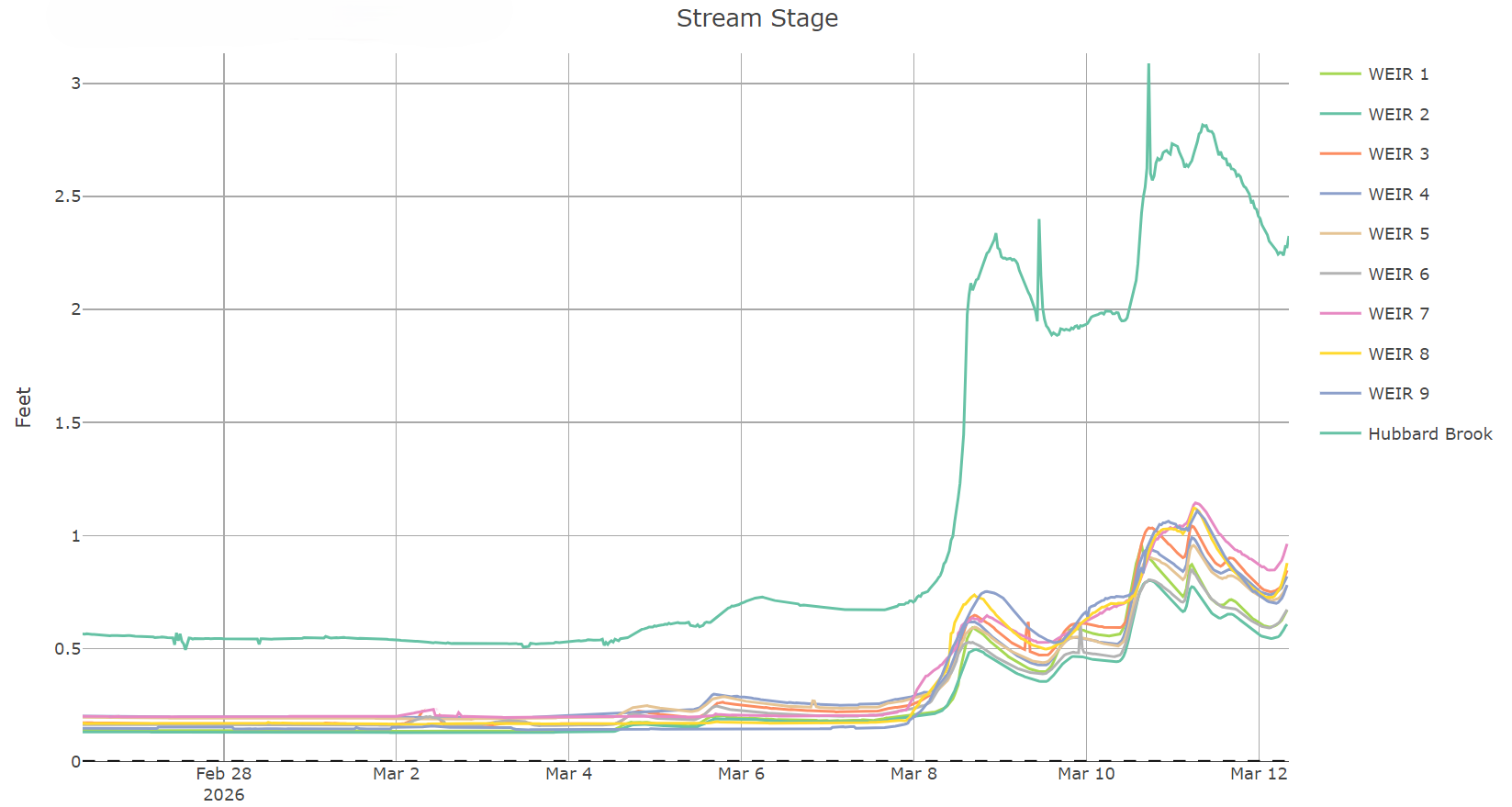
Since the last big snowfall in late January, consistently cold temperatures have kept snow and ice intact, and stream levels have remained low. Now conditions are changing. This snapshot of raw real time data, collected as part of long-term monitoring at the Hubbard Brook Experimental Forest, shows this past week's sudden rise in streamflow.
Remote sensors monitor water levels at nine small headwater streams in the forest as well as the larger Hubbard Brook that they all flow into, recording new measures every 15 minutes.
They convey this data via a wireless network to a central computer at the Robert S. Pierce Laboratory, the U.S. Forest Service's Hubbard Brook headquarters.
In this graph you can see stream stages (heights) rising during the warm, sunny days and then drop overnight, as cold temperatures temporarily stop the progress of snowmelt. "This pattern of undulating traces produces one of my favorite Hubbard Brook graphs," said Hannah Vollmer, Field Operations Manager. "It's the first sign of the upcoming growing season. My other favorite stream graph comes in late summer when streams are also showing sharp daily rises and falls, but at that time the variation is due to low rain and photosynthesis: stream levels drop during the day and rise overnight when the plants take their rest.